
Injury Recovery in Greater Victoria, BC - Call us to book an appointment: (250) 382-0018
Diversified Health Clinic
  • Welcome
  • About
    • Meet our Team
      • Dr. Matthew Bryan DC
      • Dr. Tessa Bryan DC
      • Dr. Krisjan Gustavson DC
      • Dr. Alexia Grelson DC
      • Dr. Ian Hyams MD
      • Kanu Priya, (MPT)
      • Spirit Donahue MPT
      • Morag Hart RMT
      • Craig Lawrence RMT
      • McKenzie Connell RMT
      • Braedan Pearce RMT
      • Angelina Schaaf BCAK
      • Christian Schwarz BCAK
      • Annie Wang R.Ac, R.TCM.P
      • Rebecca Thompson, R.Ac, R.TCM.P
      • Lauren Ching R.Ac
      • Laura Grohovac CCC
    • Our Clinic
    • Careers
  • Disciplines
    • Disciplines
      • Chiropractic
      • Physiotherapy
      • Registered Massage Therapy
      • Kinesiology
      • Acupuncture
      • Clinical Counselling
      • Personal Training
    • Treatments
      • Spinal Decompression
      • Shockwave
      • Class IV K Laser
      • eToims Needle-less IMS
      • Orthotics
      • Pelvic Floor Physiotherapy
  • Conditions
    • Plantar Fasciitis
    • Running Injuries
    • Allergies
    • Concussion Treatment
    • Bursitis
    • Tennis Elbow
    • TMJ Disorder
    • Automobile Collisions
    • Nerve Pain with Sciatica
    • Sport Injuries
    • Stress
    • Runner’s Knee
    • Vertigo & Vestibular Rehab
    • Concussions
  • Pricing
  • News & Events
    • News
    • Events
    • Practitioners In Focus
    • Exercise Library
  • Contact
  • ICBC Claims
  • Book Now!
  • News
  • Menu Menu
  • Link to Facebook
  • Link to Instagram
  • Link to X
  • Link to Youtube
  • Link to Rss this site
  • Link to Mail
  • Welcome
  • About
    • Meet our Team
    • Our Clinic
    • Careers
  • Disciplines
  • Conditions
  • Pricing
  • News
    • News & Advice
    • Practitioners In Focus
  • Contact
  • ICBC Claims
  • Book Now!
Health Information

Is Your Pain Acute Or Chronic?

Is Your Pain Acute Or Chronic?Most of us experience aches and pains from time to time, but aches and pains are not just for the over 50 crowd!

Types of Pain

Acute pain – is an intense and short-lived pain, usually caused by an injury.  When the injury heals the pain goes away.

Chronic pain – is pain that lasts much longer than acute pain and can be either mild or severe and lasts for months or even years.

How do health care practitioners classify pain?

Pain can be classified into nociceptive  (somatic, visceral),  or non-nociceptive  (neuropathic, sympathetic & referred) pain.

Nociceptive Pain – specific pain receptors sense temperature, vibration, and chemicals released from damaged cells; this pain is typically localized and constant.   Examples include fractures, burns, sprains, or inflammation.

Somatic pain – is when the nerves detect pain in the skin, joints, muscles and deep tissues. For example if you cut your skin, the pain you experience is somatic pain.

Visceral Pain –  these pain receptors sense inflammation in the internal organs. Examples of visceral pain is back pain.

Non-Nociceptive Pain  –   is the pain that comes from the nervous system where there are no specific pain receptors.

 Neuropathic pain  – is the result of an injury or disease in the central nervous system.  Nerves can become compressed by tumors, scar tissue, or by infection.  The pain may persist for months or years. Neuropathic pain is usually chronic, and in many cases is not fully reversible.

Sympathetic pain – occurs after a fracture or a soft tissue injury where the skin around the injury become extremely sensitive and painful.

Referred pain – is when the pain is felt either next to, or at a distance from the origin of an injury. For example, when a person has a heart attack, the pain can be felt around the arms, shoulders and back.

Measuring Pain

Pain is a very individual experience and is nearly impossible to measure objectively. A common way to assess pain is to use a numerical rating scales which asks the patient to rate their pain from 0 to 10.

Pain can be a red flag that points to a disease, illness or injury, so contact your health care provider if:

  • Your pain persists beyond 5 days
  • You have severe, unexplained pain
  • You have any sign of infection
  • You have an unexplained rash
  • Your pain is associated with starting a  ew medicine

Please contact our clinic if you have any questions regarding your health!

June 25, 2013/by Carmen Scott
0 0 Carmen Scott https://www.diversifiedhealth.ca/wp-content/uploads/2026/01/DiversifiedHealth-logo.png Carmen Scott2013-06-25 06:51:222013-06-25 06:51:22Is Your Pain Acute Or Chronic?
Acupuncture

Study Finds, Acupuncture Is Safe in Children

Treatment by acupunctureNew York Times – Guest Article By Anahad O’Connor

According to a large new study in the journal Pediatrics, the short answer is yes — in the hands of a trained practitioner. The study, the first large-scale systematic review on the safety of pediatric acupuncture, found that about one in 10 children had experienced mild side effects, like bruising and pain and numbness at the puncture site. More serious side effects, like infections and nerve impairment, were rare.

Large studies in the past have generally focused on acupuncture in adults and found similar complication rates, with serious side effects occurring in about five of every million treatment sessions.

Acupuncture is one of the most common alternative medicines in the United States, practiced by about three million people — mostly adults — every year. But it is also used with growing frequency in children to relieve pain, migraines and other complaints. About 150,000 children in the United States underwent acupuncture in 2007, according to government estimates. Whether acupuncture poses any particular hazards to children, however, has not been entirely clear.

In the latest study, researchers at the University of Alberta in Canada focused specifically on children, combing through data from 37 international studies. The authors cast a wide net, pooling data from high-quality randomized trials conducted over the past few decades as well as single case reports of injuries.

Over all, out of 1,422 children and teenagers who were included in the analysis, 168 experienced “mild” side effects. More serious problems were rare and tended to be limited to clinics that did not adhere to strict safety standards, including 12 cases of “deformity” from damage to a muscle in the thumb, all reported from the same clinic in China between 1983 and 1989. In another case, a 15-year-old boy in the United States had to be treated with “an extended course” of antibiotics when he developed a fever after undergoing acupuncture and chiropractic treatment for back pain.

“I would say the circumstances in which the serious harms happened do not reflect the modern-day standard of training and credentialing,” said Dr. Sunita Vohra, a professor of medicine at the University of Alberta and an author of the study. “That kind of practice is not what would be expected in most places.” Most American states and Canadian provinces now regulate acupuncture to ensure certain standards of safety and certification, though the regulations vary by state.

The research, financed in part by the Canadian Institutes of Health Research, did not try to answer whether acupuncture is actually effective in children. While some studies have shown that acupuncture can ease chronic neck and back pain and migraine symptoms in adults, “the amount of research done in kids is pretty minimal,” said Michael Waterhouse, the head of acupuncture at the University of California, Los Angeles, pediatric pain program. He added that the results he sees in children who are treated with acupuncture at U.C.L.A. “are as good as the results we get in adults,” though more research is needed.

“There have been some small studies on migraine showing it’s helpful in reducing their frequency and increasing endorphin levels, but that has not been repeated,” he added.

One study from Harvard Medical School in 2000 looked at the effects of acupuncture on a group of about 50 children, most of them teenagers seeking relief from migraines or endometriosis, a condition that can cause painful menstruation. “Most families found acupuncture pleasant and helpful, even for pain that had been very resistant to standard treatment,” the authors wrote. “Although some began with anxiety about the needles and misgivings about the treatment, many developed more positive attitudes over the course of treatment.”

The researchers nonetheless said they believed more research was needed before the results could be generalized to other young patients. “Most of the patients in this study were adolescents; younger children’s experiences might be quite different,” they wrote. “Future studies will need to examine children’s and families’ experience with acupuncture for the entire spectrum of illnesses for which it is used.”

June 19, 2013/by Diversified Health Clinic
0 0 Diversified Health Clinic https://www.diversifiedhealth.ca/wp-content/uploads/2026/01/DiversifiedHealth-logo.png Diversified Health Clinic2013-06-19 09:43:222013-06-19 09:43:22Study Finds, Acupuncture Is Safe in Children
Guest Bloggers/Articles

Your Healthy Greek Yogurt Harbors A Deadly Secret

Guest Article – Co.Exist

Greek yogurt is healthy and good, but the process of making it creates something called acid whey. Acid whey is very bad: accidental spills of it have killed thousands of fish. But Greek yogurt is booming, so what to do with its dangerous byproduct?

For every container of Greek yogurt you see on a supermarket shelf, picture another container (or two or three) of deadly poison. It’s called acid whey, and it’s a toxic byproduct from the yogurt-making process that’s becoming a big problem for manufacturers as their product continues its assault on the hearts and minds of health-conscious Americans.

Never heard of “acid whey?” Neither had we. Modern Farmer explains:

It’s a thin, runny waste product that can’t simply be dumped. Not only would that be illegal, but whey decomposition is toxic to the natural environment, robbing oxygen from streams and rivers. That could turn a waterway into what one expert calls a “dead sea,” destroying aquatic life over potentially large areas. Spills of cheese whey, a cousin of Greek yogurt whey, have killed tens of thousands of fish around the country in recent years.

The scale of the problem—or opportunity, depending on who you ask—is daunting. The $2 billion Greek yogurt market has become one of the biggest success stories in food over the past few years and total yogurt production in New York nearly tripled between 2007 and 2013. New plants continue to open all over the country. The Northeast alone, led by New York, produced more than 150 million gallons of acid whey last year, according to one estimate. (Emphasis mine.)

Possible solutions to the acid whey problem include farmers mixing it with cattle feed, incorporating it into fertilizer, or making biogas from it. Another is using it to make baby-food. But nobody’s really figured it out. As Cornell dairy scientist Dave Barbano told Modern Farmer: “Because the Greek yogurt production grew so rapidly, no one really had the time to step back and look at the other viable options.”

The cheese industry has solved its whey problem by selling the stuff to companies that make body-building supplements. But the “sweet whey” produced from cheese-making is richer in protein than acid whey, and therefore easier to process.

For now, it remains a mystery what will become of all that whey. But by all means, keep eating the Greek yogurt and feeling good about yourself.

Zak Stone is a staff writer at Co.Exist and a co-founder of Tomorrow Magazine.
June 17, 2013/2 Comments/by Diversified Health Clinic
0 0 Diversified Health Clinic https://www.diversifiedhealth.ca/wp-content/uploads/2026/01/DiversifiedHealth-logo.png Diversified Health Clinic2013-06-17 11:51:082013-06-17 11:51:08Your Healthy Greek Yogurt Harbors A Deadly Secret
Acupuncture, Chiropractic Care, Physiotherapy

What’s the Difference Between a Headache and a Migraine?

What is the Difference Between a Headache and a Migraine?Tension headaches and migraines are both considered types of headaches; with tension headaches being the most common.

The most frequent reason for a tension head ache is muscle tension and is generally associated  with postural problems. Tension headaches tend to be caused by stress, exhaustion, noise and eye strain. Tension headaches are frequently linked to disk problems or degenrative bone disease within the neck or spinal column.

A migraine headache or vascular headache is known by a throbbing or pulsating pain.  Migraine headaches are often incapacitating and are associated with nausea or vomiting, disrupted sleep, pain in the neck and head area, sensitivity to light, sound and certain odors. Certain foods, like aged cheese and red wine, can trigger headaches and migraines, so take a look at what you are eating.  An easy way to track potential trigger foods is to start a food journal.

Your headache may be a migraine if you have a combination of these symptoms:

  • Moderate to severe pain
  • Sensitivity to light, noise or odors
  • Blurred vision
  • Nausea or vomiting
  • Loss of appetite
  • Sensations of being very warm or cold
  • Fatigue or Dizziness
  • flashing dots or lights

If you think your  headache might be a migraine, please see a health care practitioner for your treatment options. You want to make sure that you have your neck and upper and lower back checked by your health care practitioner to rule out any structural causes caused by tightened muscles in the the neck and back regions.

Sometimes headaches can signal a more serious problem. You should talk to your health care practitioner about your headaches if…

  • You have several headaches per month
  • You have nausea, vomiting, vision, or suffer from numbness or tingling
  • You have a severe headache with a stiff neck or pain around the eye or ear
  • You have a headache with confusion, loss of alertness or loss of speech
  • You have a headache after a blow to the head
  • You used to be headache-free, but now experience frequent headaches

 “Although the exact cause of migraine headaches isn’t completely understood, medical researchers believe that migraine headaches are caused by altered blood flow and abnormal levels of naturally produced substances in the brain. When blood flow is decreased, certain arteries dilate and cause pain producing chemicals to be released. Additionally, the dilation causes an increase in the natural substance levels. This makes the blood vessels lining the brain swell and creates pressure on nearby nerves.  These nerves send pain signals to the body that are typically felt around the eye or temple region and can extend to the face, sinus, jaw, or neck.“

A health care practitioner can determine if your headache is a migraine, and can prescribe the best treatment option – Chiropractic, Acupuncture or Physiotherapy for your unique symptoms.

June 11, 2013/by Carmen Scott
0 0 Carmen Scott https://www.diversifiedhealth.ca/wp-content/uploads/2026/01/DiversifiedHealth-logo.png Carmen Scott2013-06-11 09:09:292013-06-11 09:09:29What’s the Difference Between a Headache and a Migraine?
Health Information

Is Your Gym Making You Sick?

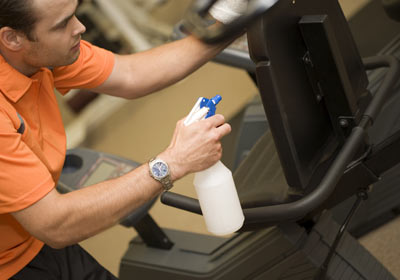
Is Your Gym Making You Sick?A single piece of gym equipment may have hundreds of users on any given day, and we all know that not everybody cleans the machines after they have finished their workout.

Sweat is not the only issue, there are viruses, bacteria, germs and even bed bugs that can live on surfaces for a few seconds, up to 48 hours.

Cleaning of the gym equipment, change rooms, floors and reception area should be a top priority for all fitness facilities.

Most fitness centres do clean their machines and facility on a schedule, but it is still easy to become exposed to another person’s sweat and germs if you use a machine right after someone else has just finished.

To protect yourself, here are some options for keeping  the gym equipment clean both before and after your workout.

Vinegar and Water-Based Disinfectant

Mix a 50/50 solution of water to white vinegar and place in a spray bottle and keep it on hand to wipe down the machines. Carry a small spray bottle in your gym bag and spray the solution directly onto the machine before use and wipe thoroughly.

A water-based cleaning solution should be sprayed on every machine and surface in the facility, including the mats and flooring to prevent the spread of athlete’s foot.  Many gyms offer spray bottles and paper towels for patrons to wipe down machines, but be sure to bring your own… just in case.

Wet Wipes

These are a fast and efficient way to clean the equipment if you do not want to be bothered with a spray bottle.

Hand Sanitizer

Frequent hand washing is essential to reduce the risk of germ transmission. Remember that most people will touch a wide variety of equipment and surfaces.  If your facility does not have hand-sanitizer dispensers mounted on the walls, bring your own small bottle of  hand sanitizer to use.

Towels

While towels will not kill viruses or bacteria, they  can provide a barrier  between you and the equipment, as well as “mopping up” sweat  by the last person; so bring a few extra towels to your workout.

Both sweat and cleaning products can break down vinyl and foam padding and these cracks and rips can become a breeding ground for bacteria. If you have to use a piece of equipment with a rip or crack, place a clean towel over the “lesion” and let the facility know of the crack or rip, so that they can repair the material asap!

A gym is a place where you can improve your health, but it can also be a breeding ground for viruses and germs, so protect yourself by using the above guidelines.

June 6, 2013/1 Comment/by Carmen Scott
0 0 Carmen Scott https://www.diversifiedhealth.ca/wp-content/uploads/2026/01/DiversifiedHealth-logo.png Carmen Scott2013-06-06 12:21:002013-06-06 12:21:00Is Your Gym Making You Sick?

Search our Blog

Search Search

Topics of Interest

Acupuncture Back Pain Chronic Back Pain Chronic Pain Custom Orthotics Diversified Health Clinic Victoria BC Dry Needling eToims exercise fitness Foot pain GoodLife Fitness Victoria Marathon Headaches Health Care Victoria Health Tips Healthy lifestyle Immune System IMS Inflammation Joint Pain Knee Injuries Low Back Pain Marathons Migraines natural health practitioner orthotics Pain management Pain Relief Physiotherapy physiotherapy victoria bc Plantar fasciitis Registered Massage Therapist Registered Massage Therapy Runner's knee Running Seasonal Allergies Skin Cancer Spinal Decompression Sports Injuries Stress Stretches Sunscreen Victoria therapeutic massage Vitamins walking

Categories

  • Acupuncture
  • Athletic Therapy
  • Careers
  • Chiropractic Care
  • Events
  • Exercise Library
  • Fitness
  • Guest Bloggers/Articles
  • Health Information
  • Massage Therapy
  • News
  • Orthotics
  • Physiotherapy
  • Practitioners in Focus
  • Uncategorized
  • Victoria Healthcare News
  • Video Library

Archive

News & Events

  • About Matthew Bryan, DC November 7, 2025
  • The Benefits of Shockwave Therapy Treatments February 28, 2023
  • Piriformis Syndrome: A Real Pain in the Butt January 31, 2023
  • Searching for a Personal Trainer in Victoria to Help You Achieve Your Goals? December 31, 2022
  • Are Winter Blues + Holiday Stress Making You Feel Grinchy?  November 28, 2022
  • Fact or Fiction? Is Joint Pain Worse in Cold Weather? October 28, 2022
  • Pelvic Health During Pregnancy and Postpartum Workshop September 26, 2022

patients choice winner

A Victoria, BC Chiropractor winner of the Patients’ Choice Awards.Verified by Opencare.com

Diversified Health Clinic

The Mosaic Building
1063 Fort St, Victoria, BC
V8V 3K5, Canada
250-382-0018
Monday7 a.m. – 7 p.m.
Tuesday7 a.m. – 7 p.m.
Wednesday7 a.m. – 7 p.m.
Thursday7 a.m. – 7 p.m.
Friday7 a.m. – 7 p.m.
Saturday9 a.m. – 4 p.m.
SundayBy Appointment
© Copyright - Diversified Health Clinic. Website by Victoria's iDreamDigital.
  • Link to Facebook
  • Link to Instagram
  • Link to X
  • Link to Youtube
  • Link to Rss this site
  • Link to Mail
Scroll to top Scroll to top Scroll to top

Would you like to learn more about our COVID-19 Protocols?

Our ProtocolsDismiss

Cookie and Privacy Settings


How we use cookies

We may request cookies to be set on your device. We use cookies to let us know when you visit our websites, how you interact with us, to enrich your user experience, and to customize your relationship with our website.

Click on the different category headings to find out more. You can also change some of your preferences. Note that blocking some types of cookies may impact your experience on our websites and the services we are able to offer.

Essential Website Cookies

These cookies are strictly necessary to provide you with services available through our website and to use some of its features.

Because these cookies are strictly necessary to deliver the website, refusing them will have impact how our site functions. You always can block or delete cookies by changing your browser settings and force blocking all cookies on this website. But this will always prompt you to accept/refuse cookies when revisiting our site.

We fully respect if you want to refuse cookies but to avoid asking you again and again kindly allow us to store a cookie for that. You are free to opt out any time or opt in for other cookies to get a better experience. If you refuse cookies we will remove all set cookies in our domain.

We provide you with a list of stored cookies on your computer in our domain so you can check what we stored. Due to security reasons we are not able to show or modify cookies from other domains. You can check these in your browser security settings.

Google Analytics Cookies

These cookies collect information that is used either in aggregate form to help us understand how our website is being used or how effective our marketing campaigns are, or to help us customize our website and application for you in order to enhance your experience.

If you do not want that we track your visit to our site you can disable tracking in your browser here:

Other external services

We also use different external services like Google Webfonts, Google Maps, and external Video providers. Since these providers may collect personal data like your IP address we allow you to block them here. Please be aware that this might heavily reduce the functionality and appearance of our site. Changes will take effect once you reload the page.

Google Webfont Settings:

Google Map Settings:

Google reCaptcha Settings:

Vimeo and Youtube video embeds:

Other cookies

The following cookies are also needed - You can choose if you want to allow them:

Privacy Policy

You can read about our cookies and privacy settings in detail on our Privacy Policy Page.

Privacy Policy
Accept settingsHide notification only