
Injury Recovery in Greater Victoria, BC - Call us to book an appointment: (250) 382-0018
Diversified Health Clinic
  • Welcome
  • About
    • Meet our Team
      • Dr. Matthew Bryan DC
      • Dr. Tessa Bryan DC
      • Dr. Krisjan Gustavson DC
      • Dr. Alexia Grelson DC
      • Dr. Ian Hyams MD
      • Kanu Priya, (MPT)
      • Spirit Donahue MPT
      • Morag Hart RMT
      • Craig Lawrence RMT
      • McKenzie Connell RMT
      • Braedan Pearce RMT
      • Angelina Schaaf BCAK
      • Christian Schwarz BCAK
      • Annie Wang R.Ac, R.TCM.P
      • Rebecca Thompson, R.Ac, R.TCM.P
      • Lauren Ching R.Ac
      • Laura Grohovac CCC
    • Our Clinic
    • Careers
  • Disciplines
    • Disciplines
      • Chiropractic
      • Physiotherapy
      • Registered Massage Therapy
      • Kinesiology
      • Acupuncture
      • Clinical Counselling
      • Personal Training
    • Treatments
      • Spinal Decompression
      • Shockwave
      • Class IV K Laser
      • eToims Needle-less IMS
      • Orthotics
      • Pelvic Floor Physiotherapy
  • Conditions
    • Plantar Fasciitis
    • Running Injuries
    • Allergies
    • Concussion Treatment
    • Bursitis
    • Tennis Elbow
    • TMJ Disorder
    • Automobile Collisions
    • Nerve Pain with Sciatica
    • Sport Injuries
    • Stress
    • Runner’s Knee
    • Vertigo & Vestibular Rehab
    • Concussions
  • Pricing
  • News & Events
    • News
    • Events
    • Practitioners In Focus
    • Exercise Library
  • Contact
  • ICBC Claims
  • Book Now!
  • News
  • Menu Menu
  • Link to Facebook
  • Link to Instagram
  • Link to X
  • Link to Youtube
  • Link to Rss this site
  • Link to Mail
  • Welcome
  • About
    • Meet our Team
    • Our Clinic
    • Careers
  • Disciplines
  • Conditions
  • Pricing
  • News
    • News & Advice
    • Practitioners In Focus
  • Contact
  • ICBC Claims
  • Book Now!
Health Information

Facts You Should Know About Sun Safety

SunSafety8If you spend any time out in the sun, you should familiarize yourself with these sun safety facts.

 – More and more folks are adding umbrellas to their must haves for a day at the park or beach.  Umbrellas can be deceiving by making you think that you’re safer than you really are. Up to 80 percent of UV rays can bounce off reflective surfaces such as sand, concrete and water, and reach you under the umbrella. Regardless of where you are outside… use sunscreen!

 – Many medication, including some antibiotics, birth control pills, and antihistamines can make you sun sensitive. Always read the information sheet that comes with your prescription to see if the medication has a warning about sun sensitivity.

– Use the “shadow rule” as an easy way to help you gauge the strength of the sun.  If your shadow is shorter than you, that means that the sun is at its strongest, as well as the UV index. On average the strongest time for the sun is between 11:00am – 2:00pm.

– Don’t forget to use sunscreen on small body parts. We often concentrate on arms, legs and backs, but forget places like ears, fingers, toes, back of the neck, and back of the knees. Heads need protection too, so wear a wide brimmed hat to help protect your scalp.

– Sunglasses protect your eyes and the delicate skin around your eyes from serious sun-damage, including eye diseases, cataracts and skin cancer. Make sure the sunglasses you pick are close-fitting and that they offer 99-100% UV protection.

– Even when it’s cloudy outside, you need to wear sunscreen. UVA and UVB rays are not filtered by the clouds or by shade – allowing about 80% of the damaging rays to reach the earth. When outside, always where sunscreen.

– Waterproof sunscreens and water-resistant sunscreens are different. On average water-resistant sunscreen gives you about 40 minutes of sun protection in the water, while waterproof sunscreen provides about 80 minutes. Regardless of which type of sunscreen you use, always re-apply after swimming.

– Don’t wait to apply your sunscreen till you have reached your destination. It takes about 15 to 30 minutes for sunscreen to sink into your skin and start working, so always apply sunscreen before you leave your home.

– The average life expectancy of a bottle of sunscreen – according to the expiration date is 2 years.  However, sunscreens are often exposed to extreme heat, cold, and tops can be left open which can allow bacteria to enter the bottle which can destabilize the formula. To be safe, purchase new sunscreen every year.

– You can use clothing for sunscreen, but do your homework. A white cotton t-shirt provides an SPF of approximately 5 to 7, while a dark denim shirt with long sleeves can provide 100% protection. A good test is to hold your piece of clothing up to a light or window; if a large amount of light comes through the clothing, it won’t provide adequate protection. Consider hi-tech sun-protective clothing and accessories; many of them have a UPF rating (Ultraviolet Protection Factor) of 50 or higher.

So the next time you head outdoors, make sure you follow these sun safety rules.
June 18, 2015/by Carmen Scott
0 0 Carmen Scott https://www.diversifiedhealth.ca/wp-content/uploads/2026/01/DiversifiedHealth-logo.png Carmen Scott2015-06-18 12:27:192015-06-18 12:27:19Facts You Should Know About Sun Safety
Health Information

What’s in Your Sunscreen?

sunscreenMost of us use sunscreen, but other than looking at price and the SPF levels, we know relatively little about what we are putting on our bodies. We use sunscreen to avoid a sunburn and to limit our exposure to the sun’s harmful rays.

Here’s what you should know about UVA and UVB Rays:

UVA rays:
• Can pass through glass, such as a car window
• Are always present despite changes in altitude or weather, season and time of day
• Can penetrate deep into skin layers
• Totals 5% of the sun’s rays

UVB rays:
• Can’t pass through glass
• Can cause the skin to burn/tan
• Intensity of rays change with the weather conditions, altitude, season and time of day
• Totals 0.5% of the sun’s rays

Theoretically when applying sunscreen, the higher the sun protection factor – SPF – the more time you can spend out in the sun before suffering a sunburn.  This is not true: at least for high-SPF sunscreens of SPF 50 and over. Many studies have found that people are misled by the claims on high SPF sunscreen bottles.

Most of us assume that we’ll get twice as much protection from SPF 100 sunscreen as from SPF 50. In reality, the extra protection is negligible and gives a false sense of security, which leads to  longer stays stay in the sun, and overexposing ourselves to UVA and UVB rays.

Numerous studies show that sunscreen users apply the wrong amount of sunscreen.  The average person uses about one-half the quantity of sunscreen that the manufacturers recommends. Applying too little sunscreen or reapplying it too infrequently diminishes protection against free radical formation which can lead to skin cancer.

How much sunscreen should you be using? You should use approximately two milligrams of sunscreen per square centimeter of skin. This means applying two tablespoons of sunscreen to the exposed areas of the face and body, and remembering that sunscreen needs to be reapplied every two hours.

High SPF products require higher concentrations of active chemicals than lower SPF sunscreens, and some of these ingredients may pose health risks when they penetrate the skin. Sunscreen formulas come in two forms, mineral and chemical.

Mineral sunscreens use zinc oxide and/or titanium dioxide.

Chemical sunscreen products typically include a combination of two to six active ingredients such as: oxybenzone, avobenzone, octisalate, octocrylene, homosalate and octinoxate.

The table below outlines human exposure and toxicity information for nine approved sunscreen chemicals.

ChemicalEWG Hazard ScoreUse in U.S. sunscreensSkin PenetrationHormone disruptionSkin AllergyOther concernsReferences
UV filters with higher toxicity concerns
Oxybenzone8WidespreadDetected in nearly every American; found in mother’s milk; 1-to-9% skin penetration in lab studiesActs like estrogen in the body; alters sperm production in animals; associated with endometriosis in womenRelatively high rates of skin allergyJanjua 2004, Janjua 2008, Sarveiya 2004, Gonzalez 2006, Rodriguez 2006, Krause 2012
Octinoxate (Octylmethoxycinnamate)6WidespreadFound in mothers’ milk; less than 1% skin penetration in human and laboratory studiesHormone-like activity; reproductive system, thyroid and behavioral alterations in animal studiesModerate rates of skin allergyKrause 2012, Sarveiya 2004, Rodriguez, 2006, Klinubol 2008
UV filters with moderate toxicity concerns
Homosalate4WidespreadFound in mothers’ milk; skin penetration less than 1% in human and laboratory studiesDisrupts estrogen, androgen and progesteroneToxic breakdown productsKrause 2012, Sarveiya 2004, SCCNFP 2006
Octisalate3Widespread; stabilizes avobenzoneSkin penetration in lab studiesRarely reported skin allergyWalters 1997, Shaw 2006 Singh 2007
Octocrylene3WidespreadFound in mothers’ milk; skin penetration in lab studiesRelatively high rates of skin allergyKrause 2012, Bryden 2006, Hayden 2005
UV filters with lower toxicity concerns
Titanium Dioxide2 (topical use), 6 (powder or spray)WidespreadNo finding of skin penetrationNo evidence of hormone disruptionNoneInhalation concernsGamer 2006, Nohynek 2007, Wu 2009, Sadrieh 2010, Takeda 2009, Shimizu 2009, Park 2009, IARC 2006b
Zinc Oxide2 (topical use), 4 (powder or spray)Widespread; excellent UVA protectionLess than 0.01% skin penetration in human volunteersNo evidence of hormone disruptionNoneInhalation concernsGulson 2012, Sayes 2007, Nohynek 2007, SCCS 2012
Avobenzone2Widespread; best UVA protection of chemical filtersVery limited skin penetrationNo evidence of hormone disruptionRelatively high rates of skin allergyKlinubol 2008, Bryden 2006, Hayden 2005, Montenegro 2008
Mexoryl SX2Uncommon; pending FDA approval; offers good, stable UVA protectionLess than 0.16% penetrated the skin of human volunteersNo evidence of hormone disruptionSkin allergy is rareBenech-Kieffer 2003, Fourtanier2008

Chemical sunscreens permeate the skin to some degree, and recently have been linked to tissue damage and potential hormone disruption.

“Laboratory studies of several sunscreen chemicals indicate that they may mimic hormones and disrupt the hormone system (Krause 2012, Schlumpf 2001, 2004, 2008).

Two European studies have detected sunscreen chemicals in mothers’ milk, indicating that the developing fetus and newborns may be exposed to these substances (Schlumpf 2008, Schlumpf 2010).”

Mineral Sunscreens are made with zinc oxide and titanium dioxide, and generally rate better than chemical sunscreens for toxicity.

Many sunscreens contain anti-inflammatory chemicals that can prevent skin from looking  sunburned. This is a problem because if you can’t see your body turning red, you assume you are adequately protected from the sun’s rays…but that’s not true.

Consumers are being lulled into thinking that their sunscreen is providing more protection than it actually does, and the result is that they stay out longer in the sun and increase their risk of skin cancer and skin damage.  So when it comes to sunscreens, do your homework!

June 15, 2015/by Carmen Scott
0 0 Carmen Scott https://www.diversifiedhealth.ca/wp-content/uploads/2026/01/DiversifiedHealth-logo.png Carmen Scott2015-06-15 07:35:482015-06-15 07:35:48What’s in Your Sunscreen?
Health Information

How to Make Your Own Sunscreen

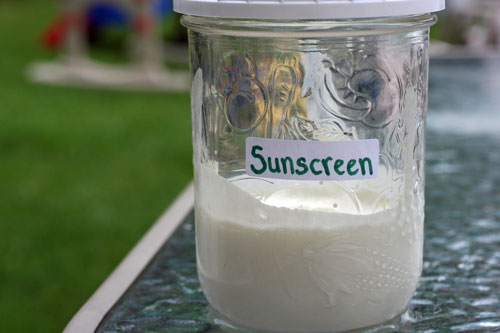
Make Your Own SunscreenChoosing the right sunscreen can be tricky. Many store-bought feature chemicals as a base, and some sunscreens can even cause contact dermatitis!

Learn more about sunscreen allergies.

If you feel that you are getting nowhere on finding the right sunscreen for you and your family, why not try making your own!  There are dozens of sunscreen recipes that you can find on the internet.

Natural Homemade Sunscreen Ingredients:

  • 1/4 cup oil (coconut, olive or almond)
  • 5 tsp Zinc Oxide (must be pure zinc oxide)
  • 1 Tbsp Beeswax
  • 3 Tbsp natural aloe vera gel (no alcohol or propylene glycol)
  • 1/2 cup distilled water

How To Make Natural Sunscreen:

  1. Heat oil and beeswax on double boiler until just melted, remove from heat
  2. Add zinc oxide powder to a bowl that will not be used for food.
  3. In small pan, heat water and aloe vera until warm.
  4. Add the water/aloe mixture slowly to the zinc oxide while whisking.
  5. Add the oil and beeswax mixture
  6. Add an essential oil (optional) for fragrance   (not citrus oil)
  7. Store in a container with a lid and keep in the fridge

Additional Notes:

  • This sunscreen will need to be reapplied often. (watch closing the first time you use it… I have never been sun burned using this recipe, but remember that everyone is different)
  • DO NOT inhale the Zinc Oxide
  • This recipe has an SPF of about 20: adding more Zinc Oxide will increase the SPF
  • Add more beeswax to make thicker sunscreen, less to make smooth sunscreen- adding 3 to 4 times the amount of beeswax and removing the water will make a “sunscreen bar” that rubs on like stick deodorant

Sunscreen in a minute:

Get a bottle of your favorite lotion that does not contain any citrus oils, and add a couple of tablespoons of Zinc Oxide, shake well and Voila!

June 11, 2015/5 Comments/by Carmen Scott
0 0 Carmen Scott https://www.diversifiedhealth.ca/wp-content/uploads/2026/01/DiversifiedHealth-logo.png Carmen Scott2015-06-11 05:44:192015-06-11 05:44:19How to Make Your Own Sunscreen
Acupuncture

Seasonal Allergies

allergiesIf you suffer from seasonal allergies you might want to consider visiting an acupuncturist.  The goal of the acupuncturist is to develop a plan which addresses the person’s acute symptoms and provides relief, while addressing the underlying immune system imbalance which is thought to be at the root of the person’s allergies.

Symptoms of Seasonal Allergies

  • Sneezing
  • Coughing
  • Watery eye
  • Nasal congestion
  • Runny or stuffy nose
  • Postnasal drainage
  • Ear congestion
  • Itchy sinuses, throat, eyes, or ear canals
  • Adenoid swelling -this occurs when the lymph tissue that line the back of the throat swells
  • Dark circles under the eyes – caused by swelling and discoloration from congestion of small blood vessels beneath the skin in the eye area.

If your symptoms are persistent and last for more than two weeks you should see your allergist  or acupuncturist for proper testing, diagnosis and treatment. Finding and treating the source of your suffering can also clear up other unwanted symptoms. Less common symptoms may include: headache, shortness of breath, coughing, or wheezing.

Decreasing Your Summer Allergy Triggers:

  • Try to stay indoors whenever the pollen count  is high – Pollen levels tend to peak in the morning
  • When the day is wind, pollen counts surge
  • Vacuum often and clean air filters regularly
  • Keep your doors and windows closed to keep allergens out, and use an air purifier
  • Wash bedding and rugs in hot water to eliminate dust mites and other allergens
  • Shower, and change clothing after going outside to wash away pollen

 If these steps still don’t provide any relief, and before you turning to over-the-counter antihistamines, decongestants, nasal sprays and eye drops speak with your healthcare practitioner to discuss all your options for treatment; including acupuncture.

A recent study conducted in South Korea examined the effectiveness of acupuncture for the treatment of chronic rhinosinusitis and allergic rhinitis.

Acupuncture treatment plans for allergies will vary greatly from person to person.  The possible results will range from temporary relief to complete remission. Acupuncture frequently relieves nasal congestion and sneezing as soon as the needles are inserted.

If you suffer from seasonal allergies please contact our acupuncturist for more information on how she can help with your allergy symptoms.

June 1, 2015/by Carmen Scott
0 0 Carmen Scott https://www.diversifiedhealth.ca/wp-content/uploads/2026/01/DiversifiedHealth-logo.png Carmen Scott2015-06-01 12:56:202015-06-01 12:56:20Seasonal Allergies

Search our Blog

Search Search

Topics of Interest

Acupuncture Back Pain Chronic Back Pain Chronic Pain Custom Orthotics Diversified Health Clinic Victoria BC Dry Needling eToims exercise fitness Foot pain GoodLife Fitness Victoria Marathon Headaches Health Care Victoria Health Tips Healthy lifestyle Immune System IMS Inflammation Joint Pain Knee Injuries Low Back Pain Marathons Migraines natural health practitioner orthotics Pain management Pain Relief Physiotherapy physiotherapy victoria bc Plantar fasciitis Registered Massage Therapist Registered Massage Therapy Runner's knee Running Seasonal Allergies Skin Cancer Spinal Decompression Sports Injuries Stress Stretches Sunscreen Victoria therapeutic massage Vitamins walking

Categories

  • Acupuncture
  • Athletic Therapy
  • Careers
  • Chiropractic Care
  • Events
  • Exercise Library
  • Fitness
  • Guest Bloggers/Articles
  • Health Information
  • Massage Therapy
  • News
  • Orthotics
  • Physiotherapy
  • Practitioners in Focus
  • Uncategorized
  • Victoria Healthcare News
  • Video Library

Archive

News & Events

  • About Matthew Bryan, DC November 7, 2025
  • The Benefits of Shockwave Therapy Treatments February 28, 2023
  • Piriformis Syndrome: A Real Pain in the Butt January 31, 2023
  • Searching for a Personal Trainer in Victoria to Help You Achieve Your Goals? December 31, 2022
  • Are Winter Blues + Holiday Stress Making You Feel Grinchy?  November 28, 2022
  • Fact or Fiction? Is Joint Pain Worse in Cold Weather? October 28, 2022
  • Pelvic Health During Pregnancy and Postpartum Workshop September 26, 2022

patients choice winner

A Victoria, BC Chiropractor winner of the Patients’ Choice Awards.Verified by Opencare.com

Diversified Health Clinic

The Mosaic Building
1063 Fort St, Victoria, BC
V8V 3K5, Canada
250-382-0018
Monday7 a.m. – 7 p.m.
Tuesday7 a.m. – 7 p.m.
Wednesday7 a.m. – 7 p.m.
Thursday7 a.m. – 7 p.m.
Friday7 a.m. – 7 p.m.
Saturday9 a.m. – 4 p.m.
SundayBy Appointment
© Copyright - Diversified Health Clinic. Website by Victoria's iDreamDigital.
  • Link to Facebook
  • Link to Instagram
  • Link to X
  • Link to Youtube
  • Link to Rss this site
  • Link to Mail
Scroll to top Scroll to top Scroll to top

Would you like to learn more about our COVID-19 Protocols?

Our ProtocolsDismiss

Cookie and Privacy Settings


How we use cookies

We may request cookies to be set on your device. We use cookies to let us know when you visit our websites, how you interact with us, to enrich your user experience, and to customize your relationship with our website.

Click on the different category headings to find out more. You can also change some of your preferences. Note that blocking some types of cookies may impact your experience on our websites and the services we are able to offer.

Essential Website Cookies

These cookies are strictly necessary to provide you with services available through our website and to use some of its features.

Because these cookies are strictly necessary to deliver the website, refusing them will have impact how our site functions. You always can block or delete cookies by changing your browser settings and force blocking all cookies on this website. But this will always prompt you to accept/refuse cookies when revisiting our site.

We fully respect if you want to refuse cookies but to avoid asking you again and again kindly allow us to store a cookie for that. You are free to opt out any time or opt in for other cookies to get a better experience. If you refuse cookies we will remove all set cookies in our domain.

We provide you with a list of stored cookies on your computer in our domain so you can check what we stored. Due to security reasons we are not able to show or modify cookies from other domains. You can check these in your browser security settings.

Google Analytics Cookies

These cookies collect information that is used either in aggregate form to help us understand how our website is being used or how effective our marketing campaigns are, or to help us customize our website and application for you in order to enhance your experience.

If you do not want that we track your visit to our site you can disable tracking in your browser here:

Other external services

We also use different external services like Google Webfonts, Google Maps, and external Video providers. Since these providers may collect personal data like your IP address we allow you to block them here. Please be aware that this might heavily reduce the functionality and appearance of our site. Changes will take effect once you reload the page.

Google Webfont Settings:

Google Map Settings:

Google reCaptcha Settings:

Vimeo and Youtube video embeds:

Other cookies

The following cookies are also needed - You can choose if you want to allow them:

Privacy Policy

You can read about our cookies and privacy settings in detail on our Privacy Policy Page.

Privacy Policy
Accept settingsHide notification only