
NBV_storeA practical guide to choosing proper footwear at New Balance. Even for the most of informed customers, buying shoes can be a daunting task due to all the technical jargon. With the help of the following tips and the guidance of a knowledgeable footwear expert, buying the appropriate footwear can be both fun and easy.

 1. Shoe sizes are not standard: Shoe sizes will vary according to the brand and the style. Do not buy a shoe according to the number associated with the size; go with how the shoe feels.

2. Both feet may not be the same size or shape: It is necessary that the bigger or most “troublesome” foot is fitted first — sacrifices may have to be made.

3. Wear the same socks that you will normally wear with the shoes

4. Be fit for the shoe late in the day or after physical activity: Be fit for the shoe later in the day — your foot expands later in the day after bearing weight.  Further, prolonged physical activity may cause your feet to swell slightly.

5. Select shoes that match the shape of your foot: Everybody has a different and sometimes unique shape to their feet (e.g., wide forefoot, narrow heel) and needs to be fitted accordingly.

6. Shoes should be slightly longer and wider than your feet. Further, the balls (i.e., front) of your feet should fit comfortably in the shoe: Do not assume the shoe will “stretch” to fit your feet. Ideally, you should feel like you could “play the piano” with your toes inside the shoe.

7. Shoes should fit comfortably in the heel: The upper of the shoe should not rub on the ankle bones and the heel should not excessively move inside the shoe.

8. Bring orthotics/inserts when you try on shoes: The orthotic/insert may change the fit and/or function of the shoe.

9. Compare a variety (e.g., 2 or 3 different pairs) of shoes and test them out in the store

10. Choose shoes appropriate for the activity: E.g., Aerobics shoes are generally not good for running on the road.

New Balance Victoria is a locally owned and operated retailer, offering the best selection of New Balance footwear and apparel in sizes and widths on Vancouver Island. We seek to provide a memorable experience through outstanding customer service and quality performance products to support your lifestyle.
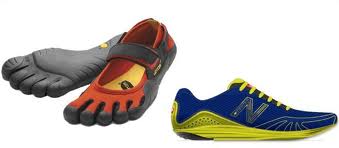
Traditional Running Shoes VS Minimalist Running ShoesThe theory behind minimalist running shoes is the less weight on the foot, the less energy you expend, and the faster, and longer, you will be able to run.

Minimalist running shoes promote a forefoot-first stride which lessens the impact of the heel strike and is bio-mechanically more natural which minimizes repetitive-motion injuries.

This is achieved by a wider and roomier toebox, (articulated toes) a minimal design that uses less material between the runner and the ground and a zero-drop heel.

Traditional Running Shoes VS Minimalist Running ShoesTraditional running shoes, with a heel-first stride, increases the impact of heel strike, which in the long-term can lead to injury or joint pain.

Manufacturers of traditional, running shoes claim stabilization and cushioning technologies can solve most personal bio-mechanical issues such as running on hard services like concrete, leg-length discrepancies, and over-pronation.

Switching from a traditional running shoe to a minimalist running shoe needs to be done very gradually.  Using a forefoot-first stride will require muscle strength and flexibility in your foot, ankle, and quads.  Due to a zero-drop heel your stride will be noticeably shorter.  Changing too quickly from a traditional running shoe to a minimalist running shoe will increase your risk of injury, so you will need to incorporate training time.

During your training period, you will need to dramatically decrease your daily mileage, avoiding steep hills and minimize running on hard surfaces.  You may want to consider starting with a runner that has a 4-8mm heel drop to help with the transition from traditional runners to zero-drop runners.

The drop refers to the difference in height of the shoe from the heel to the toe.  Traditional running shoes raise the heel anywhere from 15-25mm off the ground, with the toe of the runner measuring 8-15mm.  This difference creates a forward leaning slope which encourages heel-toe gait. The theory is that a smaller drop creates a more natural gait.

Deciding to switch to a minimalist runner?  Here are a few things to consider…

~ Don’t buy a shoe that you’re not ready for.  Perhaps a drop of is 4 or 8mm is a better place to start than a zero-drop.

~Don’t buy the wrong size, make sure it fits properly.

~Don’t buy the wrong type of shoe or buy a shoe because of the way it looks.  Minimalist running shoes are designed for different needs.  If you’re going to be running trails, buy a minimalist trail running shoe.  If you’re going to be running on the street, go for a minimalist road shoe.

~ Don’t wear a new pair of running shoes with a race coming up.  Remember that transitioning takes time.

Choosing which style of runner is best for you, comes down to which runner fits well, and works well for your personal stride, foot shape, bio-mechanical needs and the type of activity you will be engaging in.

Cassandra partially optimized proof in sRGB for internet - CopyOne of the benefits of any health or wellness program is not just the treatment, but the experience you have with your health care practitioner.  Many clients have had the same chiropractor, massage therapist or acupuncturist for years, and during that time have developed a deep trust and respect for their practitioner.

Cassandra Shkrabuik is one of Diversified Health’s registered massage therapists. Cassandra graduated from the West Coast College of Massage Therapy in a 3000 hour RMT program in 2012.  She has lived on the island for seven years and has fallen in love with the highly holistic nature of the island.

Recently I sat down with Cassandra and asked her some questions on massage therapy and on her life.

Q: Is there a benefit to having a longer massage session ( over 60 minutes )

A:  The main benefit to a longer massage is deeper relaxation, and clients suffering from multiple health issues can have all of them addressed in one session.

Q: What are 3 benefits of a massage?

A:  1. Improved circulation – Having an increase in blood flow and circulation to areas of your body helps promote cell growth and organ function.

2. Elimination of toxins through the skin  –  Skin eruptions are an indication of toxicity and the body’s attempt to eliminate them, so massage can increase the circulation to the skin and de-congest the pores.

3 The feeling of well-being  –  Massage increases the available levels of dopamine and this explains the satisfaction experienced during and after a massage. Also, serotonin regulates mood and has a calming effect; a low serotonin level has been implicated in depression, and massage seems to increase the level of available serotonin, producing an overall sense of calm.

Q: How often should you have a massage to achieve maximum health benefits?

A: Everyone is different, but with no health issues, every 4-6 weeks is a good place to start.

On a more personal note:

Q: Where is your favorite place to “chill” on the weekend?

A:  Walking and hiking in any forested area.

Q: Favorite music style?

A: Most of my day is spent listening to calming soft music with my clients, so when I get home I enjoy the fast beat of Electro-jazz and any good classic rock songs that gets you going.

Q: If you can only eat one type of food what would it be?

A:  SUSHI!!!

Q:  Name one thing that most people don’t know about you.

A: Most people don’t know that I foster cats with behaviour issues and also feral kittens.

Q: What event is a must see for you in Victoria?

A: Anything to do with fireworks, specifically Canada Day and the Symphony Splash.

Q: Where is your favorite place to “snoop” in the city?

A: With out a doubt china town, because there is always something going on!

*Cassandra works Mondays, Wednesdays, Thursdays, Fridays and Saturdays. Please contact our front desk to book an appointment with Cassandra.

Do You Eat Breakfast?We have all heard that breakfast is the most important meal of the the day, and here’s why.

If you deprive your body of food in the morning you may find that you feel tired, dizzy and have trouble concentrating. If you don’t eat anything in the morning, you will most likely find yourself craving something sweet to eat, as your body needs energy – NOW!

To compensate for no breakfast you may find yourself reaching for something very unhealthy, and you will be more likely to consume up to  twice as many calories than you would if you ate breakfast.

After a night’s sleep, your stomach is empty and requires fuel.  It makes sense that the best way to start the day is to energize and revitalize your body by eating a nutritious and healthy breakfast, that will keep you satisfied until lunch.

Our body needs a healthy breakfast packed full of vitamins and nutrients providing  us with energy and fuel for our brain.  The best types of foods to be eaten at breakfast are complex carbohydrates such as whole grains including oats, and 12 grain bread together with a small amount of fruit, yogurt and freshly squeezed juice.

These foods have a low GI (glycemic index), which means that they release glucose steadily and slowly into the bloodstream, unlike the unhealthier breakfast choices such as pastries. Foods with a low GI will keep you fuller for longer, preventing unhealthy snacking, and keep your energy levels steady while providing you with essential minerals and vitamins.

Many people like to consume some form of protein in the morning, as protein balances blood sugar levels and recent studies have also proven that concentration levels are enhanced if some form of protein is consumed during the breakfast meal.

The results are in and study after study proves that adults who eat breakfast in the morning perform better at work, have a healthier body weight and are more physically fit, so get eating!

Buying New Running Shoes?Shoes aren’t just designed for different foot shapes; they are designed for different running patterns; so a running gait analysis  is a great place to start when finding the best fit from your running shoes. When you buy, think feel and fit, not fashion.

Ask yourself these questions… Do you run for long periods – four or more times a week?  Do you run short lengths a couple times a week?

When buying running shoes, keep these tips in mind:

The time of day you shop is a factor.  Feet swell as you use them and that’s especially important to remember when buying running shoes.  Try them on at the end of the day so you have a better idea of how they’ll feel after a run.  Make sure you have a half to a full thumb’s nail length from your big toe to the end of the shoe.

Take a short run around the store to test the fit, function and comfort before you buy.

Remember to take your orthotics with you and make sure you try them out in the shoes before you purchase them. (orthotics need to be replaced every about every 18 months)

Running in old worn-out shoes is one of the most common causes of running injuries. Your shoes lose cushioning, stability and shock absorption over time. A “good” rule of thumb is to replace your running shoes every 500km.

At Diversified Health our practitioners use a gait scan to help assess your foot concerns.  As you move across a pressure plate, thousands of tiny sensors capture the distribution of pressure of your foot and the computer displays 2D and 3D visual representations of the pressure under your foot.  These findings help the practitioners to evaluate your foot function.

Please contact the clinic if you have questions about what type of running shoes would be beneficial for your fitness level and remember that a running gait analysis can help get the best fit from your running shoes.

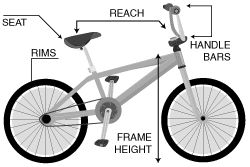
How to Properly Size Your BikeIn order to enjoy cycling without injury; the choice of bike, proper frame size, and adjustments of the handlebar, seat and pedals can play a huge part; so size does matter when choosing a bike.

Here’s how to tell if the bike is truly right for you, and specific points on how you can fine tune the seat and handlebars to make it perfectly comfortable for you.

Frame Size:

The first step is getting the right size bike, so stand over the frame with both feet flat on the ground. A properly-sized road bike frame will allow an inch or two clearance between the top tube of the frame and your crotch. A mountain bike should aim for twice this distance.

Seat Height:

Your seat height should be set to a height that allows your leg to extend until it is almost completely straight when you are sitting on the seat. There should be only a slight bend to the knee when your foot is on the pedal in the bottom position.  A common mistake is for people to think that they should be able to sit on their seat touch the ground.  For maximum comfort, you want your seat to be level.

Handlebar Position
The goal of handlebar height adjustment is to find the position where you can ride comfortably without putting strain on your back, shoulders or wrists

Your handlebars should be at least as high as your seat, or even above it, so you can ride upright. If your handlebars are lower than your seat you’ll be pushed into your handlebars, and you’ll place more stress on your wrists, arms, neck, and back.

Making sure your bike fits is of utmost importance to cycling injury free.